top of page


Why Wild Animal Captivity Matters
Wild animals are not ours to confine for entertainment, convenience, or profit. Their lives are shaped by movement, social relationships, choice, and environments that captivity can rarely replicate.
Even when animals are well fed and their enclosures meet legal standards, captivity still places human interests at the center of their lives. Zoos, roadside attractions, encounters, performances, and other captive settings decide where animals live, who they live with, when they move, breed, eat, and interact.
CWI believes wild animals should be protected in the wild whenever possible. When animals cannot be released, genuine sanctuary should prioritize their autonomy, social needs, safety, and lifelong care—not visitor access or entertainment.
Why Captivity Harms Wild Animals
Wild animals evolved to live in environments that allow them to travel, forage, hunt, explore, choose social partners, avoid conflict, and respond to changing conditions. Captivity restricts many of those choices, sometimes dramatically.
The result can be chronic frustration, stress, abnormal repetitive behaviors, social disruption, and physical problems that are rarely visible in a quick visitor experience. A clean enclosure and regular feeding do not necessarily mean that an animal’s behavioral and psychological needs are being met.
The more wide-ranging, socially complex, or highly intelligent the species, the harder those needs can be to reproduce in captivity. Elephants, big cats, primates, marine mammals, and many other wild animals may spend their entire lives adapting to environments designed around human management rather than their own freedom.

Inuka, Singapore Zoo, died April 2018
Do Zoos Really Support Conservation?
Zoos often justify keeping wild animals in captivity by pointing to conservation, education, and breeding programs. Some institutions do contribute money, research, or expertise to species recovery efforts. But those contributions do not automatically make captivity itself ethical—or necessary.
Most animals displayed in zoos are not endangered, and many captive breeding programs do not result in animals being returned to the wild. For some species, breeding primarily maintains a captive population rather than restoring a wild one.
Conservation is most effective when it protects animals where they naturally live: preserving habitat, reducing human-wildlife conflict, combating poaching and trafficking, and supporting local communities that share landscapes with wildlife.
CWI believes conservation should be judged by what it does for animals and ecosystems in the wild—not by how effectively captivity is marketed to visitors.
Further Reading
Conservation Education: Are Zoo Animals Effective Ambassadors and Is There Any Cost to Their Welfare? — Spooner et al., 2021
The Show Can’t Go On — World Animal Protection
Most Captive-Born Predators Die If Released — National Geographic, 2008
Critics Question Zoos’ Commitment to Conservation — National Geographic, 2003
Modern Zoos Are Not Worth the Moral Cost — New York Times, 2021 (Opinion)


Sanctuary Is Not the Same as Attraction
The word sanctuary is powerful, but it is not a guarantee of good animal welfare. Some facilities use sanctuary language while still offering close-contact encounters, photo opportunities, performances, breeding, or other activities designed around visitor access.
A genuine sanctuary exists primarily for the animals in its care. Animals are not required to perform, entertain visitors, or participate in unnecessary interactions. Their ability to choose where to spend their time, whether to approach people, and how to interact with other animals should matter more than creating a memorable experience for guests.
That distinction matters because many travelers genuinely want to help animals and can be misled by compassionate-sounding language. Before visiting or donating, look beyond the name of the facility and ask what the animals are actually expected to do.

The Preserve in Texas is NOT a sanctuary.
How to Choose More Ethical Wildlife Experiences
If you are considering visiting a wildlife facility, look closely at what the experience asks animals to do. Ethical treatment is not defined by attractive grounds, friendly staff, or words like rescue, sanctuary, or conservation.
Be cautious of facilities that offer direct contact with wild animals, staged photo opportunities, rides, bathing, feeding sessions, performances, tricks, or encounters that require animals to participate on demand.
Better signs include large naturalistic spaces, appropriate social groupings, opportunities for animals to avoid visitors, no breeding for display, no performances, and clear policies that place animal welfare above entertainment.
Whenever possible, choose experiences that support animals living freely in their natural habitats rather than paying to see wild animals confined for human access.
What You Can Do
You do not need to visit or financially support facilities that keep wild animals in captivity in order to care about them.
Choose wildlife experiences that protect animals in the wild, support reputable sanctuaries that do not exploit animals for entertainment, and avoid attractions built around close contact, performances, rides, or photo opportunities.
You can also help by asking questions before you visit, sharing concerns with friends and family, supporting campaigns that challenge harmful captivity, and directing your money toward organizations working to protect animals rather than display them.
Want to support ethical animal sanctuaries, but still don't know where to start? CWI can help. Donations to our The ReWild Fund go exclusively to sanctuaries approved by us caring for animals related to our active campaigns.
Small choices matter most when they become shared expectations. The more people reject exploitative attractions, the less profitable those attractions become.
Take Action for Wild Animals
Wild animals deserve more than protection from obvious abuse. They deserve lives shaped by their own needs—not by what makes them profitable, entertaining, or convenient for us.
CWI works to challenge the exploitation of wild animals in circuses, zoos, roadside attractions, tourist encounters, and other forms of captivity.
Learn more. Speak out. Take action.

Anti-Captivity Protest Materials
(click image to download. for marine mammal captivity materials, click here.)
Anchor 4

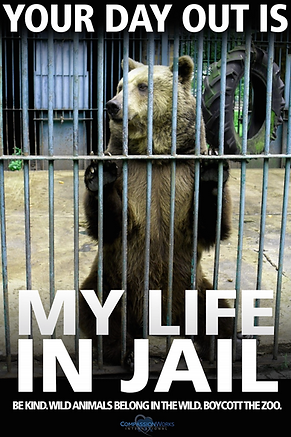


Anti-Captivity Leaflet
(click image to download. for marine mammal captivity
materials, click here.)


bottom of page