TROPHY HUNTING
IS A CRIME AGAINST NATURE.
Killing wild animals for trophies turns sentient beings into status symbols. CWI opposes trophy hunting because animals are not prizes, decorations, or commodities.
Why Trophy Hunting is Wrong.
Trophy hunting asks the public to accept a disturbing idea: that an animal’s life can be ended for pleasure if enough money changes hands.
CWI rejects that premise. Conservation should be rooted in protection, coexistence, habitat preservation, and respect for wildlife — not in selling opportunities to kill animals for sport. No amount of branding can change what trophy hunting is: a recreational activity in which an animal is pursued, shot, and reduced to a trophy.
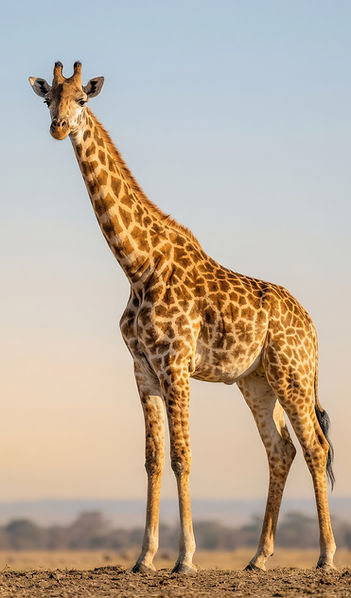
The animals killed by trophy hunters are not abstract “resources.” They are individuals. Elephants mourn, remember, and maintain lifelong family bonds. Lions live in complex social groups. Giraffes, bears, wolves, leopards, and countless other species experience fear, stress, pain, and loss. Their lives matter to them, and their deaths matter to the families, groups, and ecosystems they leave behind.
Wild animals are not trophies. They are individuals who deserve to live.
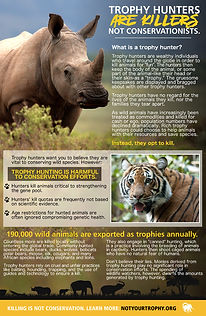
Killing is not Conservation.
Supporters often argue that trophy hunting helps conservation and local communities. But the evidence does not support the sweeping claims made by the hunting industry.
Trophy hunting is a small part of the larger tourism economy. Studies examining trophy hunting revenue in African countries have found that it represents only a tiny fraction of national economies and only a small share of overall tourism revenue. In many cases, very little of the money paid by foreign hunters reaches the rural communities most affected by living alongside wildlife.
Even when trophy hunting generates revenue, that does not make it ethical — and it does not mean it is the best available model. Wildlife is worth more alive than dead when communities are supported through non-lethal tourism, habitat protection, conservation jobs, wildlife watching, photography, guiding, lodging, and other long-term economic opportunities.
Trophy hunters often seek large, impressive animals — the biggest tusks, horns, manes, antlers, or bodies. These animals may be socially, genetically, and ecologically important.
Removing older males from elephant populations can disrupt social learning. Killing dominant lions can destabilize prides and lead to the deaths of cubs when new males take over. Targeting rare or visually impressive animals can place additional pressure on individuals whose traits hunters find desirable.
Wild animals are not interchangeable. When a trophy hunter kills an animal, the harm does not end with that individual. Families, social groups, and ecosystems can also be affected.
Trophy hunting revenue is tiny compared with tourism overall.
An Economists at Large report found that trophy hunting revenue was only 1.8% of tourism revenues across the African countries it examined, and Born Free’s summary of that report notes that trophy hunting revenue did not exceed 0.27% of GDP in any national economy studied.
Scant trophy hunting money may reach local communities. An Economists at Large study says even pro-hunting sources found only 3% of trophy hunting money reached rural communities where hunting occurs. A pro-hunting/conservation review also acknowledged that local communities “rarely benefit adequately,” citing examples such as less than 3% of trophy hunting revenue reaching local communities in Cameroon and 12% in Zambia’s Game Management Areas.
The broader trophy trade is enormous. IFAW reported that as many as 1.7 million hunting trophies were traded internationally between 2004 and 2014, including at least 200,000 trophies from threatened taxa.

Better Ways to Support Conservation.
Photo tourism can outperform hunting income in community conservancies. A 2024 study of Namibian communal conservancies found that, among conservancies earning income, photographic tourism generated 447% greater median annual income than hunting. The study also notes that both hunting and photographic tourism can produce income in some contexts, which makes the finding stronger rather than just advocacy rhetoric.
Communities living near wildlife deserve real support, safety, income, and decision-making power. But they should not be forced to rely on selling the lives of animals to foreign trophy hunters.
Better conservation models include:
-
wildlife watching and photography tourism;
-
community-owned conservancies;
-
habitat restoration and protection;
-
anti-poaching employment;
-
compensation programs for human-wildlife conflict;
-
support for coexistence tools such as predator-proof enclosures;
-
ranger, guide, and conservation jobs;
-
education and local stewardship programs; and
-
international funding that does not depend on killing animals.
The answer to underfunded conservation is not to sell more deaths. It is to invest in systems that protect wildlife and support communities at the same time.
The United States plays a major role
American hunters are among the world’s leading importers of hunting trophies. Trophy hunting is not only a distant problem happening somewhere else; it is driven in large part by international demand, including demand from the United States.
A 2023 Humane Society report found that from 2014–2018, the U.S. imported 72,617 trophies from CITES-listed mammal species, accounting for 75% of global imports of those trophies during that period.
So it MUST be a part of the solution.
When hunters import heads, skins, tusks, horns, or other body parts, they help sustain a global industry that turns wildlife into status symbols. Ending the demand for trophies is one important step toward ending the killing. The public MUST speak out against the wealthy, selfish individuals who murder for bragging rights.
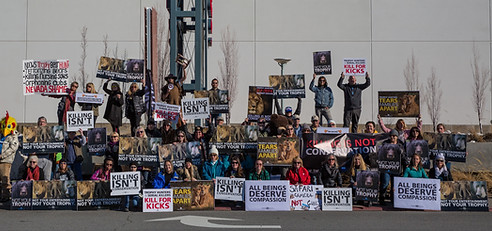
Every year, CWI protests the annual convention of Safari Club International (SCI), which is one of the world’s largest trophy hunting conventions and a marketplace for killing animals for sport, status, and profit. We began that protest after the brutal and unjust killing of Cecil the lion by U.S. dentist Walter Palmer in July 2015.
SCI has chapters around the world and in the United States that also host regional events. We encourage the protesting of every SCI event.
CWI also supports the creation of state and federal law that bans the import of trophy hunted animals. CONTACT US for support with your anti-trophy hunting efforts.

Protest Resources
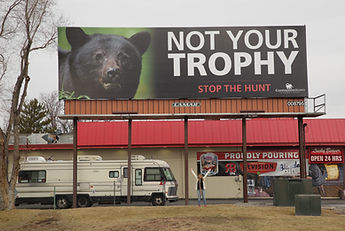
Click an image to download and print for your anti-hunt demonstrations. Need help? info@cwint.org


Leaflet front & back